Showing posts with label Cody. Show all posts

Thursday, May 3, 2012

Team Latex

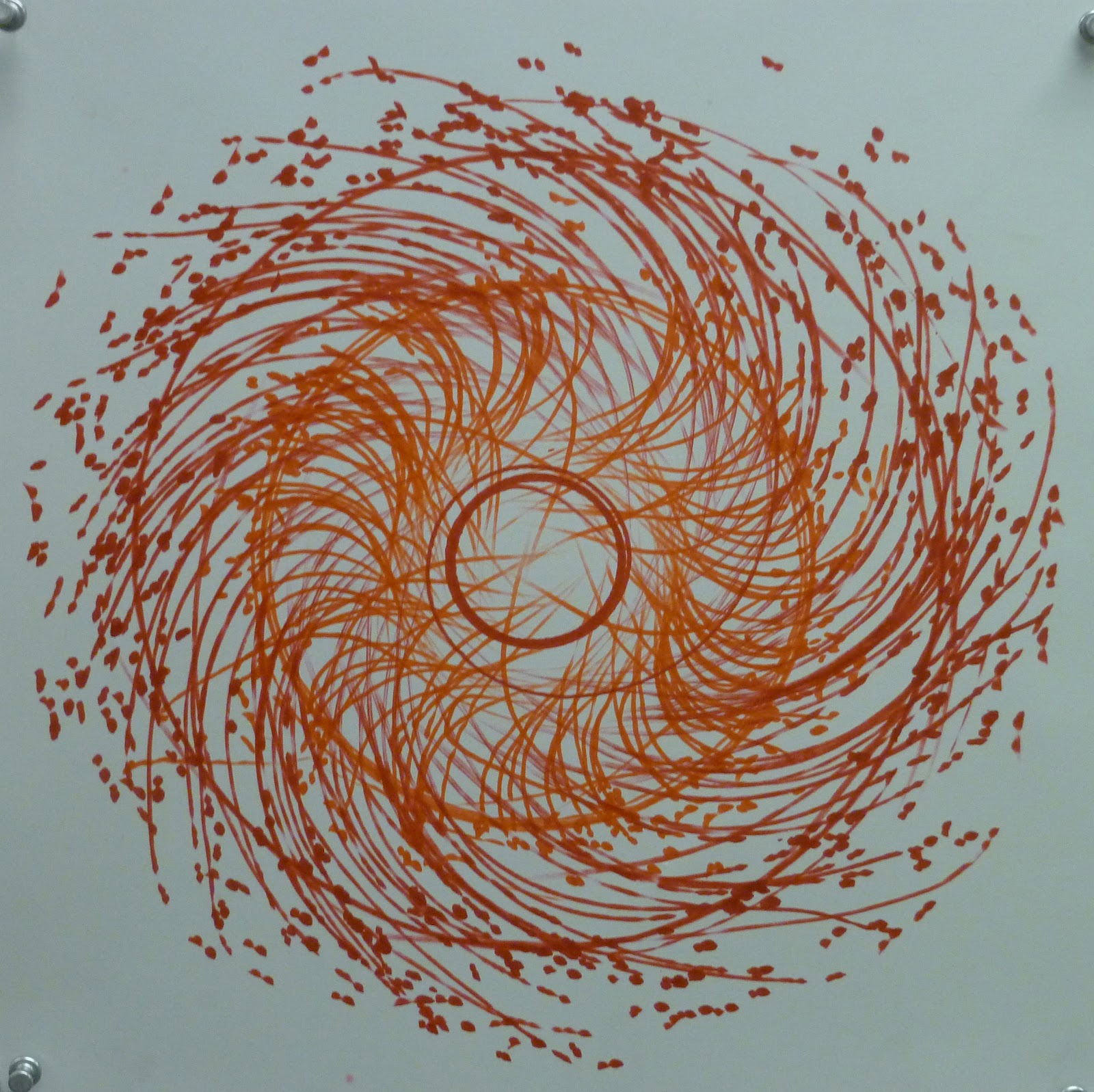
  Our charge was to create a "drawing machine" as a group. Through inspiration and discussion between us, we settled on the idea of a spinning base that holds paper while a rotating arm with some sort of mark-making device protruding from it, marking on the surface. Our final machine uses sharpies and 13"x13" paper to create the drawings. The sharpies are held in place by latex tubing on the wooden shaft, which is turned by gears attached to a crank. The wooden base is also turned by gears, which are, in turn, turned by a handle. The entire machine is human-driven, so the user/users can vary the speed and direction which the shaft and base are turning to influence the drawing.
*
Our drawing machine. Made out of 2x6 pine boards (the body of the machine), poplar wood (the shaft, gears, and handles), birch plywood (the turntable), latex tubing (attached to the shaft to hold the sharpie markers in place), and assorted metal washers and knobs.


The collaged technical drawing of our machine.

Several of the best drawings our machine produced.


Monday, March 26, 2012

Naef Stacker


For this entry into the Naef Toy Competition, we worked with the idea of singular parts fitting together to create a unified whole. The form of the toy evolved from the study of a cylinder and how pieces could fit together to form a cylindrical object.

Monday, April 19, 2010

Ruins of a Salt Maker


what happens to a building after its initial purpose has been served?

will it be reused or simply demolished?

what will happen to the materials?

will they end up in a landfill or serve another purpose?

i theorize that elements of new construction and renovation can be combined through the design process to make buildings last indefinitely.

by thinking of buildings as changing entities one may allow them to adapt to the surrounding environment.

like nature, the building changes. it weathers, it molds, it stains. it rots like a tree and grows back like a seedling.

process is of major importance. nothing is stagnant, everything is in motion. gravity is slowly tearing down walls. rain is slowly corroding roofs. some materials last a life time and some last a day. knowing how materials act together can determine the lifetime of a structure.

the cast-in-place concrete pillars provide a foundation that will last hundreds of years. the pillars are notched in a way that accommodates a timber substructure, which in turn, creates the interior spaces. the use of notched pillars can create different sizes and configurations of interior spaces. this allows the inhabitants to change the structure based on specific needs.

buildings crumble.