Showing posts with label Alveena. Show all posts

Thursday, May 3, 2012

Team Latex

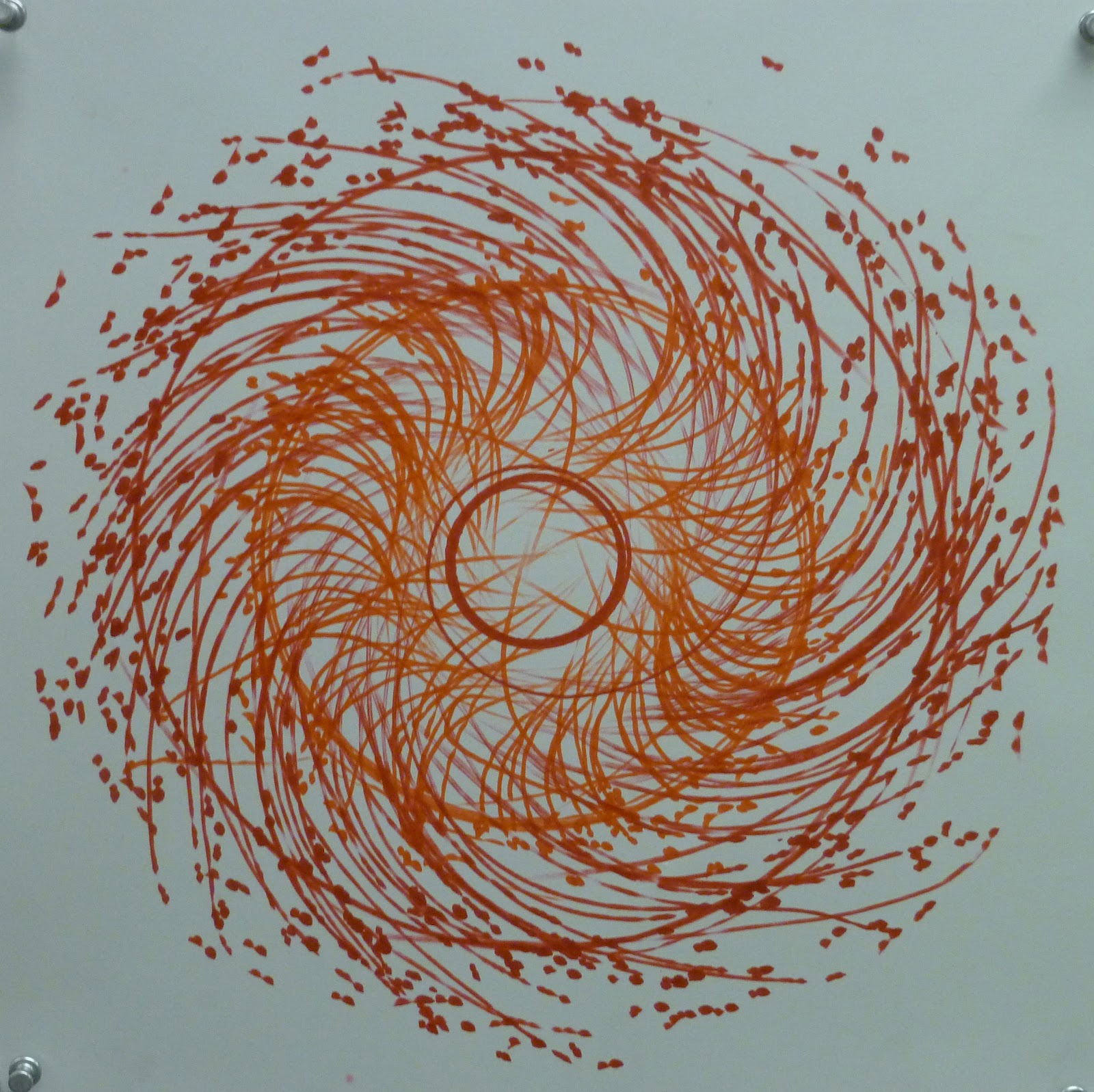
  Our charge was to create a "drawing machine" as a group. Through inspiration and discussion between us, we settled on the idea of a spinning base that holds paper while a rotating arm with some sort of mark-making device protruding from it, marking on the surface. Our final machine uses sharpies and 13"x13" paper to create the drawings. The sharpies are held in place by latex tubing on the wooden shaft, which is turned by gears attached to a crank. The wooden base is also turned by gears, which are, in turn, turned by a handle. The entire machine is human-driven, so the user/users can vary the speed and direction which the shaft and base are turning to influence the drawing.
*
Our drawing machine. Made out of 2x6 pine boards (the body of the machine), poplar wood (the shaft, gears, and handles), birch plywood (the turntable), latex tubing (attached to the shaft to hold the sharpie markers in place), and assorted metal washers and knobs.


The collaged technical drawing of our machine.

Several of the best drawings our machine produced.


Wednesday, October 19, 2011

How It All Came To Be


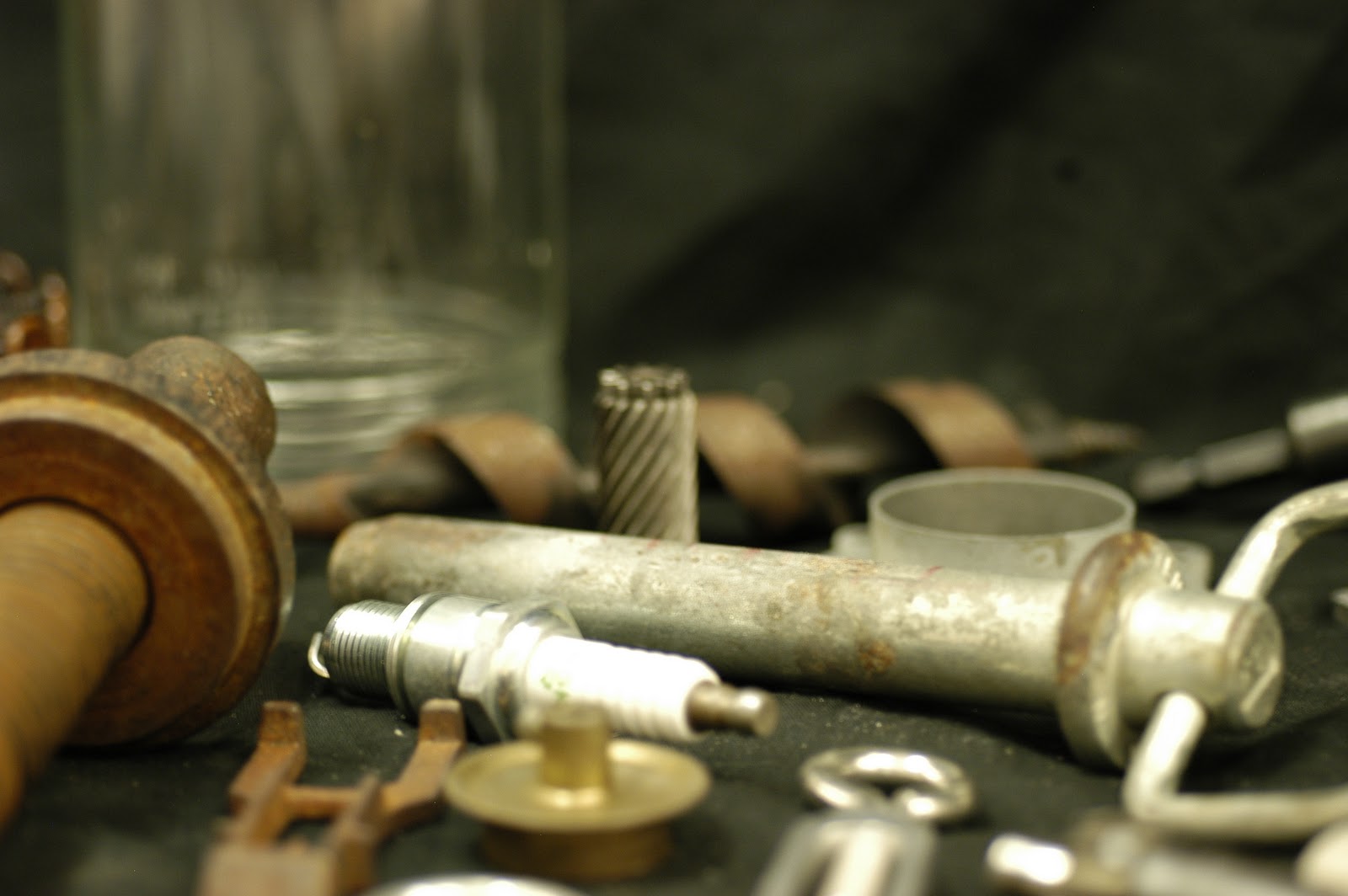
What now stands as a collection of 20 spectacular and variant structures, share a common beginning: a pile of metal “widgets.” Looking at the final models that currently decorate the desks in our studio, it is hard to fathom that we were all given the same assortment of odd metal parts to draw. We were told we could only use hard lines when drawing the widgets at a 1:4 scale. Although there seems to be little room for improvisation and the hand of creativity, each set of drawings that was presented at the end of the two week period was astonishingly different. The fact that we had all perceived beauty so differently in the arches, lines, and planes of the rusted metal parts was beautiful and poetic in itself. From the intricate and symmetrical notches on the clock cog to the delicate (and sinfully difficult to recreate) curves of the metal pin, there was a unique geometry to each widget which truly came forth in the third step of the process: creating Photoshop compositions with the widgets.
As we tinkered with our drawings on Photoshop many of us found that the drawings would oftentimes fit together seamlessly like corresponding pieces of a puzzle. However, when the drawings were forced, the compositions risked looking like “someone threw tools up into the air and let them land spontaneously on the page” (Pritchett, C.).
Just like the widget drawings evolved over the two weeks we worked on them, the compositions worked in a similar way. The first composition for many of us was not our best work (me including) but as the shapes and patterns became more obvious to us, the compositions took on a new life, and new forms.
These very compositions were then extruded into rough study models, and through the same process of evolution and discovery have become the final models that now decorate this blog page.

Widgets